
Living Trust vs Will: How Their Roles Differ
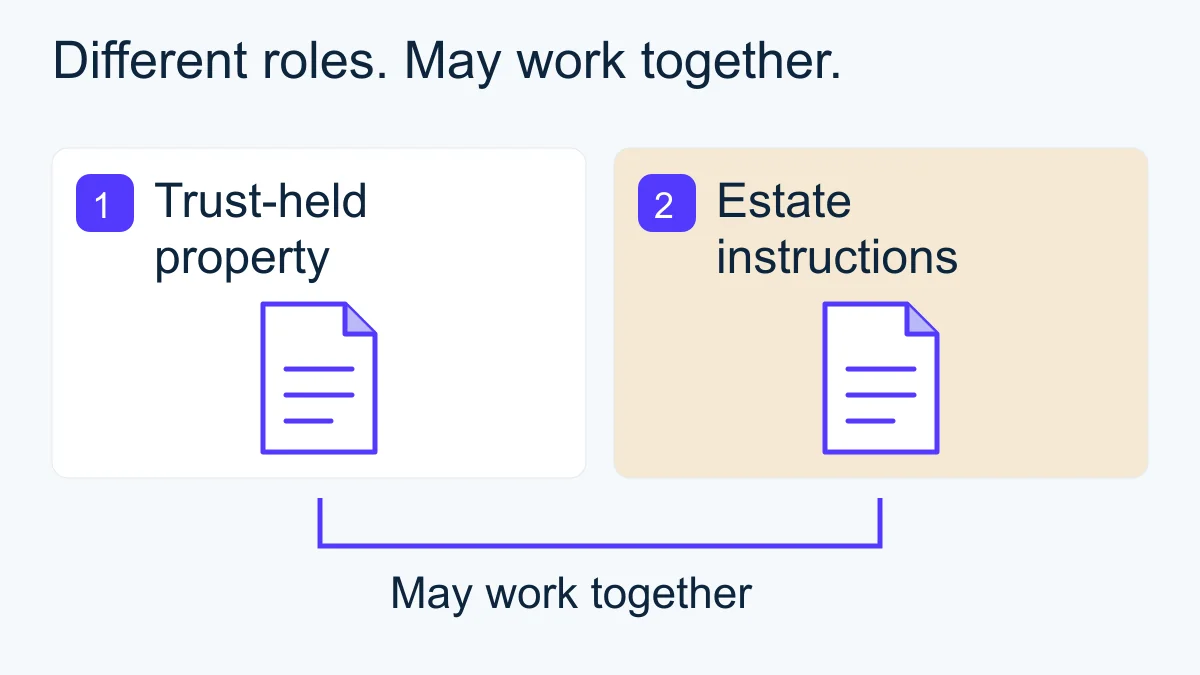
A living trust vs will comparison is about the jobs the documents perform, not a rule that everyone should choose one and discard the other. A trust concerns property held under its terms, while a will addresses matters that apply through the estate process. Some plans use both, and an unfunded trust does not automatically cover assets still owned outside it. Compare the practical differences below, including preparation and follow-up work. The right arrangement depends on your property, family circumstances, and applicable law, which this comparison cannot evaluate for you.
If you need the basic roles first, start with the living trust overview. If you already have documents, use this comparison as a review agenda: identify what each document covers, find the gaps, and write down the questions you need answered before replacing anything.
Compare the Jobs Each Document Performs
The most useful living trust vs will question is “Which task am I trying to arrange?” A will can direct distribution of probate property, nominate an executor, and express a guardian choice for minor children, subject to state law and court procedures. A trust supplies instructions for its trustee concerning trust property. The American Bar Association’s introduction to wills explains these distinct functions.
The comparison below concerns a revocable living trust, the common document people have in mind in this discussion. Specialized irrevocable arrangements require a separate assessment. The table gives a starting vocabulary; it does not determine what your state requires or whether either document fits your family.
| Planning task | Revocable living trust | Will |
|---|---|---|
| Property instructions | Directions for the trustee concerning property covered by the trust. | Directions for property governed by the will through estate administration. |
| Management during life | Can arrange management of trust property, including a successor role. | Does not itself appoint someone to manage your finances during life. |
| Responsible person | Names a trustee and usually a successor trustee. | Can nominate an executor or personal representative. |
| Preparation follow-up | Review the document, execution requirements, and appropriate asset transfers. | Review the document, execution requirements, storage, and other transfer arrangements. |
| Questions beyond property | Check companion documents for personal and health decisions. | Check guardian nominations and companion documents for decisions during life. |
The lifetime-management distinction is described in the ABA’s revocable-trust guide. Personal planning should still cover assets and decisions outside a trustee’s authority.
Property covered and work after signing
Signing a trust document and putting appropriate property under the trust are separate tasks. A trustee’s authority does not automatically extend to every asset you own. The CFPB’s explanation of revocable living trusts specifically distinguishes trust property from property outside the trust.
For your living trust vs will review, make an inventory with four entries for each item: the current owner, any existing beneficiary designation, the document you think applies, and the evidence supporting that belief. Use account records and deeds rather than a remembered description such as “our family account.” Mark uncertain entries for review instead of guessing at their legal effect.
Illustration: Morgan signs a trust agreement that describes intended beneficiaries. An old bank statement still shows Morgan individually as the owner, and Morgan has not obtained confirmation of any account change. The useful next question is whether this account has actually been placed under the trust, not whether the trust’s title looks correct. This example does not decide how Morgan’s account would pass at death.
Keep intended transfers and confirmed transfers in separate columns. A to-do list can show that you planned to call a bank, but it cannot establish that the bank accepted the change. Our guide to how to fund a living trust explains how to organize this follow-up without treating every asset alike.
Also review beneficiary designations and ownership arrangements independently of either document. The ABA notes that a will generally does not control property passing through a beneficiary designation or survivorship title. A different result may apply when the estate is the named beneficiary; the exact records matter. See its discussion of non-probate property.
When the Documents Work Together
A living trust vs will comparison can lead to a coordinated plan using both documents. In a trust-based plan, a pour-over will may direct probate property into an existing trust after death. That mechanism is a backup for particular property; it does not prove that an omitted lifetime transfer has avoided probate. The Florida Bar’s trust pamphlet discusses this arrangement specifically in Florida.
That pamphlet was updated in December 2018 and warns that legal provisions can change. Its Florida examples are useful for identifying questions, but this site does not apply its procedures, deadlines, or spousal-property rules nationwide. Obtain current local guidance for your actual documents and property.
Illustration: Alex wants one set of instructions for an investment account, a plan for a future home purchase, and a guardian nomination for a child. Alex’s review sheet gives each of those tasks a separate row. A professional can then explain which document and transfer arrangement addresses each row, rather than leaving Alex to assume that a single trust covers all three.
This approach keeps the living trust vs will decision tied to a concrete task. It also gives you a way to compare proposed packages: ask which rows the quoted service covers, what documents are included, and what work you will need to complete elsewhere. Do not infer that a package contains a will, deed preparation, or individual advice merely because its marketing describes an “estate plan.”
Bring existing documents into the same review. Write down dates, later amendments, successor names, and the location of signed originals. If two documents appear to give different instructions, preserve both and ask how they interact; do not resolve the conflict by crossing out clauses or discarding the older original.
Coordination also means giving the people you nominate a practical way to find the plan. Consider a brief private record identifying where originals are stored and whom to contact for help. Keep passwords and complete account numbers out of a general family email or a website finder; those details belong in a secure process appropriate to your situation.
Compare Preparation and Ongoing Tasks
Compare living trust versus will cost by the scope of the work quoted, not by document names alone. For your own worksheet, request separate entries for drafting, individual review, signing assistance, property-transfer help, and later changes. These are suggested comparison categories, not a national price schedule or a statement that every provider offers each item.
A useful living trust vs will budget has room for both the initial document and the tasks that make the plan usable. Record who will handle each task and whether the quoted fee includes it. A low document price tells you little about the complete scope if the quotation leaves important steps unspecified.
Use these questions when comparing services:
- Does the quote cover one person or more than one person?
- Which named documents are included, and which are separate?
- Is the service document preparation, individual legal advice, or both?
- Does anyone review existing ownership records and beneficiary designations?
- Is assistance with a particular deed or institution’s paperwork included?
- What happens if you need an amendment or a complete replacement later?
For living trust versus will cost, put answers beside the actual quote and its date. If a price is shown online, check whether it refers to a single purchase, a subscription, or a trial that renews. Do not treat “starting at” as a complete price for your facts, and do not assume that a provider’s advertised package answers questions about your state’s law.
Illustration: One quote covers a trust document and signing instructions. Another includes a trust, a will, a review meeting, and help with one deed. Their headline prices do not describe the same work. A fair comparison would first identify which tasks you need, then request an explanation of any missing or additional items; it would not declare the lower number the better choice.
Our living trust cost guide offers a more detailed scope worksheet. If you are organizing the process rather than comparing quotations, read how to set up a living trust. Use the guides to prepare questions before selecting a service.
After preparation, keep a review list for changes in property, family circumstances, nominated people, and instructions. Record the issue that needs checking rather than assuming that every change requires a new document. For example, “new bank account not yet reviewed” is more useful than a vague note to “update everything.”
Questions to bring to a professional
Take your living trust vs will comparison to a qualified professional when the answer depends on rights, taxes, property rules, or competing family interests. A productive appointment starts with a short statement of your goals and the documents you already have. Ask for an explanation connected to a particular asset or decision so you can understand the practical effect.
Prepare questions such as: Which assets would be governed by each document? Which arrangements already exist outside the estate process? Who could act if I lose capacity? What happens if a nominated person cannot serve? Which instructions require another document, and what local execution requirements apply?
For living trust versus will cost, also ask what continued work the proposed arrangement creates. Request a written explanation of the services included and the tasks left to you. The answer may be different for drafting a simple document, coordinating an existing plan, or reviewing property located in more than one jurisdiction.
If routine document preparation is the task you choose to investigate, our living trust online overview explains the external-service handoff and its boundaries. This comparison does not make a legal suitability recommendation, and a referral should never substitute for resolving a question about your rights.
Trust and Will Questions
What is the difference between a living trust and a will?
In a living trust vs will comparison, the central difference is the job and property each document addresses. A revocable trust can arrange management of trust property during life and after death; a will gives instructions concerning probate property and can nominate an executor and guardian. Those roles are summarized in the ABA’s will introduction.
Can I have both a trust and a will?
Yes. The two can be coordinated, including through a pour-over will in a trust-based plan. Ask how the documents work together and what remains outside the trust. The Florida Bar’s explanation is a Florida example, dated December 2018; it is not a statement of every state’s current procedures or a promise about any online package.
Does a trust replace every purpose of a will?
Do not assume a complete replacement. Review property instructions, executor and guardian nominations, and decisions during life as separate tasks. Ask which document addresses each one in your jurisdiction. The ABA’s overview of wills explains why a will has functions beyond simply listing beneficiaries.
Which option costs more?
Compare actual written quotations for the same work. Living trust versus will cost depends on what you are comparing: a document, a package, individual advice, transfer assistance, or ongoing service. This guide provides a scope worksheet, not national prices. Request the total current charge and any renewal terms before paying.
Does a trust avoid all probate?
Do not assume that every asset is covered or every estate will avoid probate. Check ownership and other transfer arrangements individually. The CFPB explains that a trustee does not gain authority over property outside the trust. Ask a professional about the resulting probate position under current local law.
Can an online quiz decide which I legally need?
This site’s document chooser cannot. It lists preparation options and points to educational information or an external preparation service. It does not examine your complete property records, interpret existing documents, or determine legal suitability. Use the links as navigation aids and take unresolved legal questions to a qualified professional.
Written and substantively reviewed · Educational information; individual requirements need appropriate review.