
How to Fund a Living Trust: What to Check
Understanding how to fund a living trust means checking how each intended asset becomes subject to the trust’s terms. Signing the trust document alone does not change every deed, account record, or beneficiary instruction. Different assets and institutions require different steps, and some transfers can have legal or tax consequences. Start with an inventory, identify the current ownership, and ask the relevant institution or professional what documentation is needed. This guide organizes those questions; it does not prepare a deed, transfer property, or tell you to retitle every asset.

Build an Asset Inventory Privately
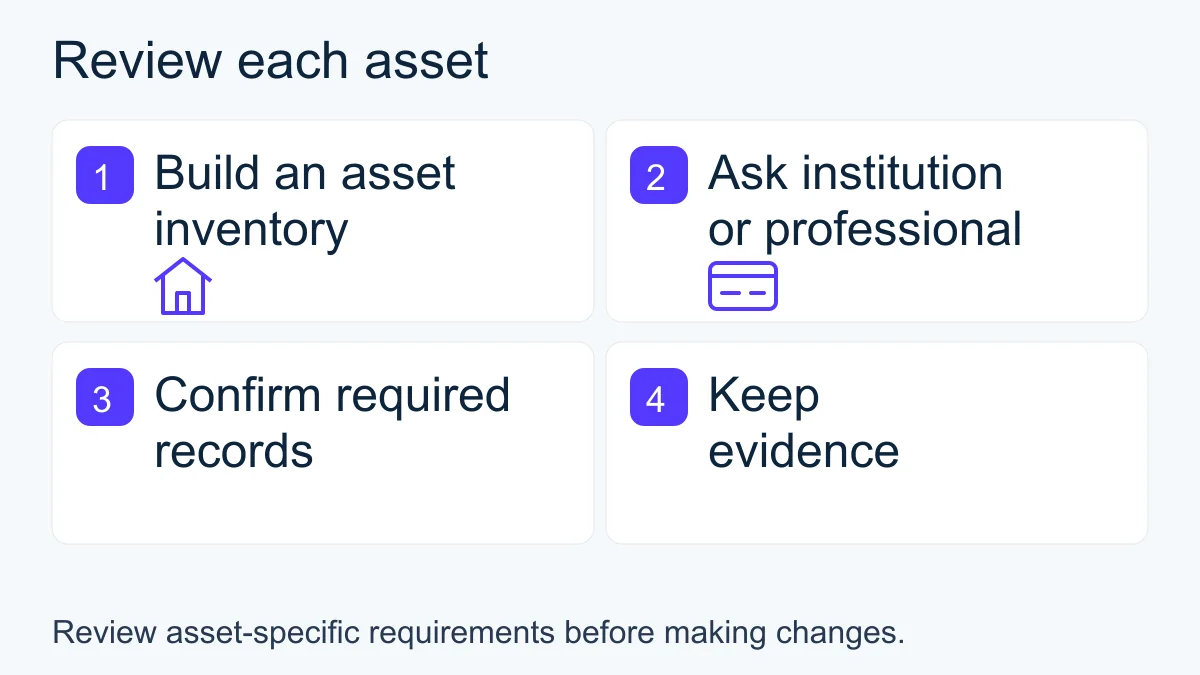
Start with what you own and how it is recorded today. A useful inventory identifies the kind of asset, its current owner, the institution or office keeping the record, and the person who can answer transfer questions. Keep account numbers, balances, copies of identification, and beneficiary details in your own secure records. You do not need to enter any of them on this website.
The CFPB’s explanation of a revocable trust makes the boundary clear: a trustee’s authority concerns property held in the trust. An inventory helps you compare that boundary with the assets you intended the document to address. Writing an asset’s name on an informal list does not establish that an institution changed its ownership record.
If you are still preparing the document, use the living trust checklist first. The guide to how to set up a living trust separates preparation and signing from funding. This page focuses on the asset follow-up that a document purchase does not automatically complete.
For how to fund a living trust, begin with an inventory that makes unresolved questions visible:
| Inventory field | What to note privately | Why it helps |
|---|---|---|
| Asset category | Deposit account, home, investment, insurance, business interest | Identifies who should review the proposed change |
| Present ownership | Names and ownership wording on the current record | Avoids assuming ownership from who uses an asset |
| Existing instructions | Beneficiary or survivorship arrangements to ask about | Separates different ways property may pass |
| Relevant contact | Institution, custodian, title professional, or adviser | Gives each question a practical destination |
| Current status | Not reviewed, advice needed, submitted, or confirmed | Keeps a request from being mistaken for completion |
This is an organizational worksheet. The status labels are not legal findings. Use “confirmed” only when you have appropriate evidence of the specific action, and retain any limitations explained by the institution or adviser.
Check the Transfer Route by Asset Type
Do not turn how to fund a living trust into a single instruction for every asset. Ownership changes, beneficiary designations, and permission for someone to act on your behalf are different arrangements. The same person may hold several roles, but that does not make the records interchangeable.
Searches such as living trust revocable transfer often combine these tasks. Before completing a form, ask what the form actually changes. Does it alter the account’s owner? Does it name someone to receive proceeds later? Does it only authorize access or identify an acting trustee? Ask the record keeper to explain the resulting entry in ordinary language.
Real estate and existing title arrangements
For real estate, gather the current recorded deed and the information needed for a professional to identify the property. Do not rely only on a mortgage statement, tax bill, or a trust schedule. Those records serve different purposes and may not answer the question of recorded title.
Bring the following questions to the person reviewing the proposed transfer:
- Who owns the property now, and what ownership language appears on the deed?
- Who must participate in or approve the proposed change?
- What deed or other instrument is appropriate for this property and jurisdiction?
- Who will prepare, review, and record that instrument?
- What mortgage, insurance, homestead, tax, or title questions need review?
- What recorded evidence should you receive after the work is completed?
These are questions to investigate, not a deed-drafting recipe. The Florida Bar’s Florida-specific discussion illustrates why title and mortgage questions need attention. Its pamphlet is marked updated December 2018; check current requirements for the state where the property is located rather than applying that example nationwide.
An illustration: a homeowner has signed a document and sent a deed request to an adviser. The inventory should show “submitted,” with the adviser’s contact and outstanding question. It should not show the home as fully funded merely because the email was sent. The next useful task is obtaining the relevant confirmation, not buying the same trust template again.
Bank and investment account records
Ask the institution about its procedure for a trust-owned account or a proposed change to an existing account. An institution may request evidence about the trust and the person acting under it. Ask which documents are necessary and how to provide them securely; do not email an entire estate file to an unverified address.
For deposit accounts, the FDIC’s official trust-account guidance discusses trust accounts within deposit insurance. That guidance helps explain the significance of account records and ownership categories. It does not certify your trust document, protect investments from market losses, or resolve a property-transfer question.
When reviewing how to fund a living trust, keep bank deposits separate from investments and tax-sensitive retirement accounts in your notes. A financial institution’s familiar name does not mean all its products have the same legal, tax, or insurance treatment.
| Asset or arrangement | Start the conversation with | Ask before submitting a change |
|---|---|---|
| Bank deposit | The bank’s account or trust-services staff | What ownership record and supporting documents are required? |
| Nonretirement investment account | Brokerage or custodian | How does this proposed change affect the account and existing instructions? |
| IRA or other retirement arrangement | Custodian and a qualified tax adviser | Is the proposal about ownership, distributions, or beneficiary designation? |
| Insurance policy | Insurer and an appropriate adviser | Are policy ownership and beneficiary instructions being reviewed separately? |
| Business interest | Attorney and the relevant company record keeper | What restrictions, agreements, and approvals apply? |
If your query was living trust revocable transfer, this table is a starting point for identifying the correct conversation. It is not a list of assets that must be transferred. The guide to assets to avoid putting in a living trust explains why some categories deserve a closer check.
Beneficiary instructions require their own review
Do not treat “name the trust as beneficiary” as an easy substitute for every ownership change. That action can raise its own questions about the document and the asset. For an IRA, IRS Publication 590-B specifically addresses a trust as beneficiary and related distribution requirements. It is federal retirement guidance, not an instruction to put your IRA into an ordinary trust-owned account.
Write the proposed action in your notes before approving it. “Review the IRA’s beneficiary designation” is more precise than “move retirement into trust.” That wording helps the custodian and adviser identify what you are asking and reduces the chance of acting on a misunderstanding.
Keep Proof and Review Outstanding Items
The practical finish for how to fund a living trust is a record you can review later. A signed request, a recorded instrument, a confirmation letter, and an updated statement are different pieces of evidence. Ask which one establishes the action you intended, then keep the relevant record with your private planning file.
Funding checklist
An illustration: your bank has acknowledged a request but has not issued an updated account record. Mark “awaiting confirmation,” record the follow-up contact, and ask what remains. A checkbox is a reminder to investigate; it cannot verify what the bank has done.
Use a short follow-up log with four fields: question, person contacted, response date, and next action. Keep the response itself if it explains a restriction or remaining step. You can use paper or your preferred private record system; this website does not store the log.
If your question about how to fund a living trust remains unanswered, keep that item open. A specific outstanding question is easier to follow up than a general note saying “trust finished.” Ask who is responsible for the next action and what confirmation you should expect.
After a new purchase, account change, move, or relevant family change, review whether your inventory still reflects the arrangement you intended. There is no universal review interval stated here. Choose a workable reminder and obtain advice when a change affects the document or an asset’s treatment.
For living trust revocable transfer questions that remain unresolved, describe the specific asset and proposed change to the relevant professional. A general search result cannot decide a title, tax, or beneficiary issue. Our revocable living trust mistakes guide helps distinguish an unfinished transfer from other document and maintenance checks.
Funding Questions
What does funding a living trust mean?
It means bringing intended property under the trust’s terms through the appropriate asset-specific process. The CFPB explains that trustee authority concerns property actually held in the trust. Learning how to fund a living trust therefore includes checking records and completion evidence, rather than assuming that signing changed ownership everywhere.
Does signing automatically transfer my assets?
No. Signing the trust document does not automatically update every deed, institution record, or beneficiary instruction. Review each intended asset separately. If you have a signed document but no confirmation from the relevant record keeper, treat the asset’s status as a question to resolve.
How do I check whether an account is held in trust?
Ask the institution to explain the account’s current ownership record and provide the relevant confirmation. Do not infer ownership solely from your personal asset list. FDIC guidance is useful for understanding bank deposit-insurance categories, but the institution’s records and the applicable documents must be checked for your actual account.
Should every asset go into the trust?
No blanket instruction applies. Retirement arrangements, insurance, jointly held property, and restricted interests require their own review. How to fund a living trust is an asset-by-asset question; some proposals involve beneficiary instructions instead of retitling, and those also need appropriate advice.
Can this website prepare my property deed?
No. It offers educational guidance and a document-option finder. It does not draft, approve, record, or transfer a deed. Use a qualified professional who can review the property, ownership arrangement, and current requirements in the relevant jurisdiction.
What records should I keep after a transfer?
Keep the confirmations appropriate to the asset: for example, an updated account record or the relevant recorded instrument. Keep submitted requests separately from completion evidence, along with any advice about limits or further steps. A living trust revocable transfer search cannot replace those records or establish that a change was completed.
Written and substantively reviewed · Educational information; individual requirements need appropriate review.